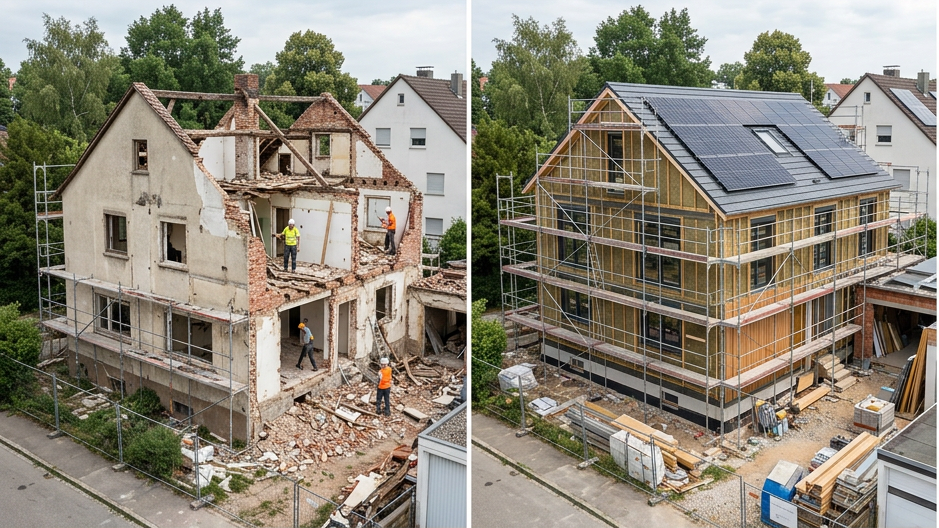

Why long-term project success is no accident–but rather the result of hard, smart work.
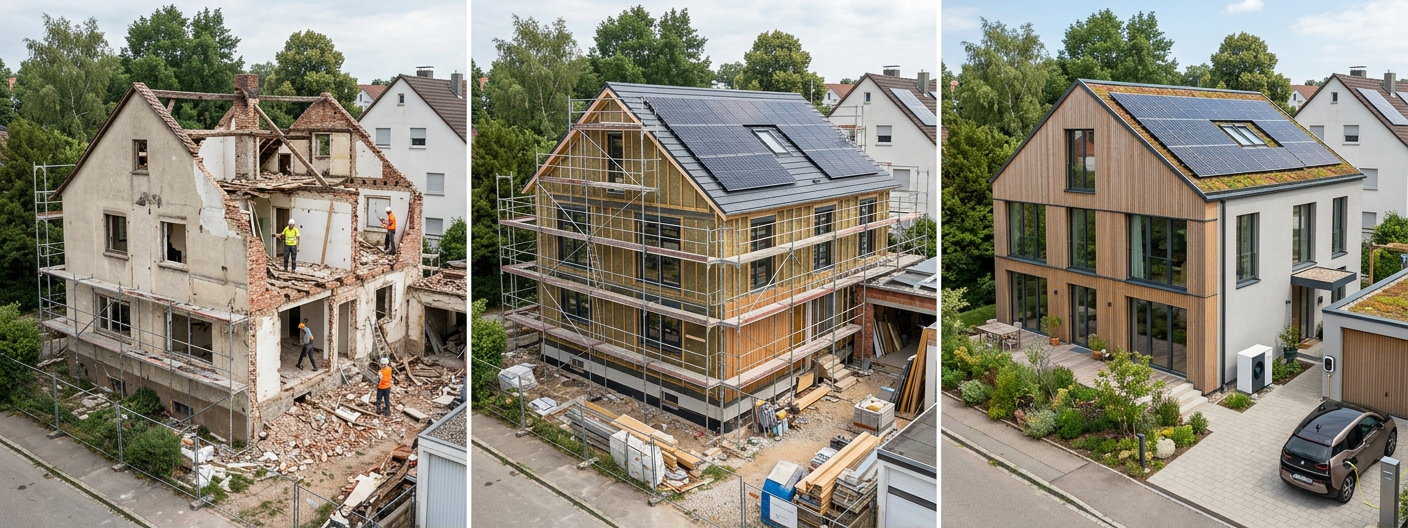
What has truly made our long-term client projects successful? Why are some systems still easy to maintain even after five, ten, or more years, while we see other projects become prohibitively expensive and sluggish?
The honest answer is: hard work, sound engineering, actively listening to stakeholders, and the willingness to continually question and improve things.
The good news: Over the years, we’ve identified patterns. Successful systems have more in common than you might think. The most important common element is flexibility.
Our thesis: The success of our solution lies in the flexibility we have achieved.
Why Does Custom Software Need Flexibility?
Today, our systems operate in a world that is constantly changing:
- Market differentiation is becoming increasingly critical – features and quality determine success or failure.
- Time-to-market is a constant – a feature that’s two months late today can cost us the market.
- Sustainable change rate – a feature that can’t be further developed will become a burden during maintenance tomorrow.
This means: We don’t just need speed – we need a sustainable rate of change. And for that, a system needs one thing above all else: flexibility.
Flexibility is required in every aspect
A common misconception is to view flexibility purely in technological terms. The reality of our projects shows otherwise: change occurs across all dimensions, and adaptability is required everywhere.
Technological Advancements
- Yesterday: Java enterprise applications, on-premises, virtual machines
- Today: cloud-native, containers & Kubernetes, edge deployments
Business & Market
- Yesterday: Consulting and sales at car dealerships
- Today: Decision-making and the purchasing process are increasingly taking place online
Development Processes
- Yesterday: Phase-based project management, manual testing, annual release planning
- Today: Agile approach with continuous deployment
Organization
- Yesterday: Separate functional departments (development, operations, business units)
- Today: Domain-oriented DevOps teams
→ Change is not the exception. It is the norm – and it is unpredictable.
Why Classical Architecture Fails Here
Many systems are no longer adapted to the changing world or evolved based on their initial design; instead, they are merely expanded as “necessary.”
If architecture does not evolve as technology, the market, and the organization change, this leads to increasing complexity, rising costs, and declining delivery capabilities.
The result is a dilemma that many teams are familiar with:
We'd love to deliver faster – but our architecture doesn't allow it.
The Solution: Continuous Architecture Modernization
The key insight from our projects is this:
Flexibility doesn’t come from a major redesign, but from continuous modernization – in parallel with feature development.
Architecture must not be a one-time project. It must become an ongoing process.
Continuous Architecture Modernization means: We are constantly modernizing–technology, architecture, team structures, and processes. And not at some point in the future, but right now, while operations are ongoing.
This approach works not only for new projects but can also be adapted for existing ones. To do this, preparations must be made to make the system ready for continuous modernization and to ensure it is stable enough to handle changes.
The Modernization Cycle
Based on our experience, a clear, repeatable two-phase process emerges.
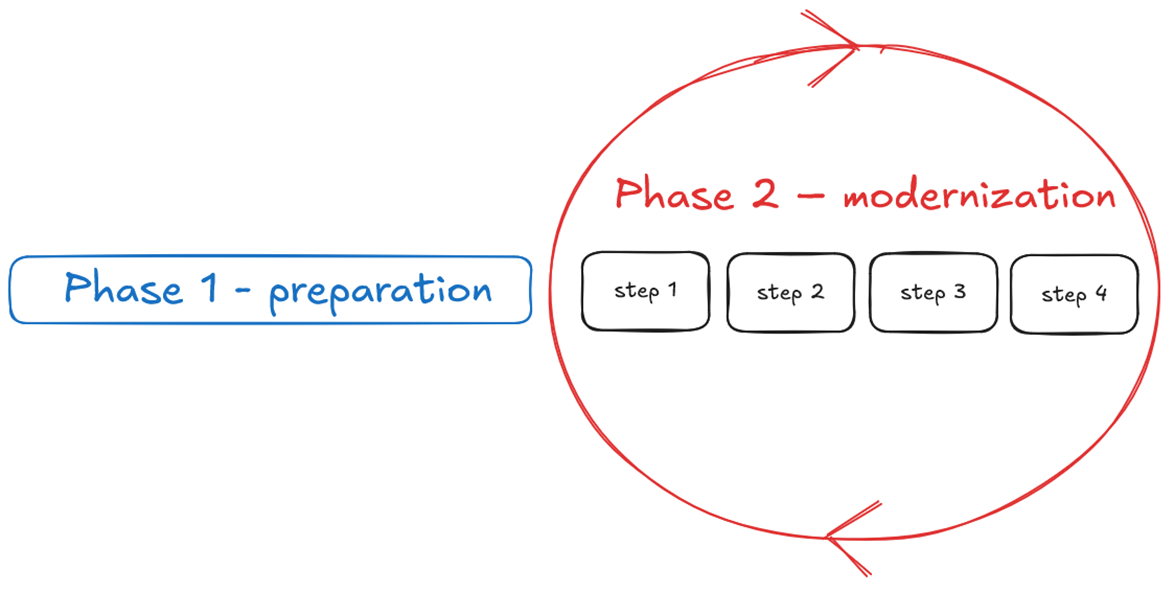
Phase 1 – Preparation
This phase applies to ongoing projects that want to adapt the process to their own needs.
Imagine an aging house that needs to be modernized. Before we can begin the modernization, the building must first be made ready for changes. It’s exactly the same in our software projects. To do this, we follow three basic steps:
1. Technical Stabilization
First, we ensure that changes are even possible. Specifically, this means we implement CI/CD pipelines and automated tests, if they aren’t already in place. We transition to Infrastructure-as-Code so that environments become reproducible and controllable. We also establish observability–logging, metrics, tracing–to immediately detect when a change has negative effects.
Without this foundation, any major change is like flying blind. With it, change becomes measurable, manageable, and safe.
2. Enable technical decoupling
In the second step, we separate the technical logic from the business logic. We create the capability to decouple technical infrastructure, frameworks, and deployment models from the actual business code.
It’s important to note that we don’t rebuild everything right away. We simply create the option to leverage this separation as the modernization process unfolds. This allows us to switch or modernize technology without having to touch the business logic every time–and vice versa. This is one of the most powerful levers for long-term flexibility.
3. Empower teams
Technical flexibility alone is not enough if the organization cannot make use of it. That is why we ensure that teams have the necessary skills to take end-to-end responsibility for a product. This includes being able to put DevOps culture and methods into practice and having decision-making authority over the business domain.
A team that isn’t allowed to deploy, can’t make decisions about its architecture, or has to wait for five other departments is structurally inflexible–no matter how modern the technology is.
Phase 2 – Continuous Modernization
The following steps are repeated iteratively in order to plan changes for the long term and implement them consistently.
Step 1: Analyze the business domain
Before you refactor code, you need to understand what the system actually does. Using methods such as domain storytelling and collaborative analysis with the business units, we ask: What domains actually exist? Where are the false assumptions? Where are dependencies unnecessary? The explicit goal here is to actively challenge our current understanding.
Step 2: Model the Target Architecture
Based on an understanding of the domain, we re-examine and redefine meaningful domain boundaries and component divisions, as well as quality objectives such as scalability, security, and modifiability.
This does not require a “Big Design Up Front,” but rather the consistent application of lightweight methodologies such as LASR for architecture reviews.
Step 3: Compare the current and target architectures
Now it's time to get specific: In what ways does the current solution differ from the target architecture? We map these differences to specific source code components and group the necessary refactorings together.
Step 4: Prioritization and Implementation
Don't do everything at once–instead, select refactorings based on their strategic impact, add them to the regular backlog, and plan them alongside features in sprints. Modernization becomes part of regular work–not a special project.
And then? Repeat. Over and over again.
After each cycle, we ask: When does the next cycle begin? What falls within the scope of the next cycle? What is the next logical step?
Modernization never ends–and that is precisely what makes it sustainable.
The Real Secret to Success
When we look at our successful projects, our “secret recipe” is surprisingly unspectacular:
- Skilled, empathetic engineers who are willing to work hard
- Continuous modernization of technology
- Continuous modernization of architecture using a domain-first approach
- Continuous modernization of the organization and development processes
Or, to put it another way:
Success arises when people constantly adapt a system in such a way that it can continue to evolve.
Conclusion
Successful software systems are not characterized by a one-time, perfect design, but by their ability to evolve continuously.
Continuous Architecture Modernization means continuously optimizing technology, architecture, processes, and organization–in parallel with feature development–rather than waiting for a major redesign.
Those who consistently implement this process create the conditions necessary to thrive in the long term in a world of constant change.