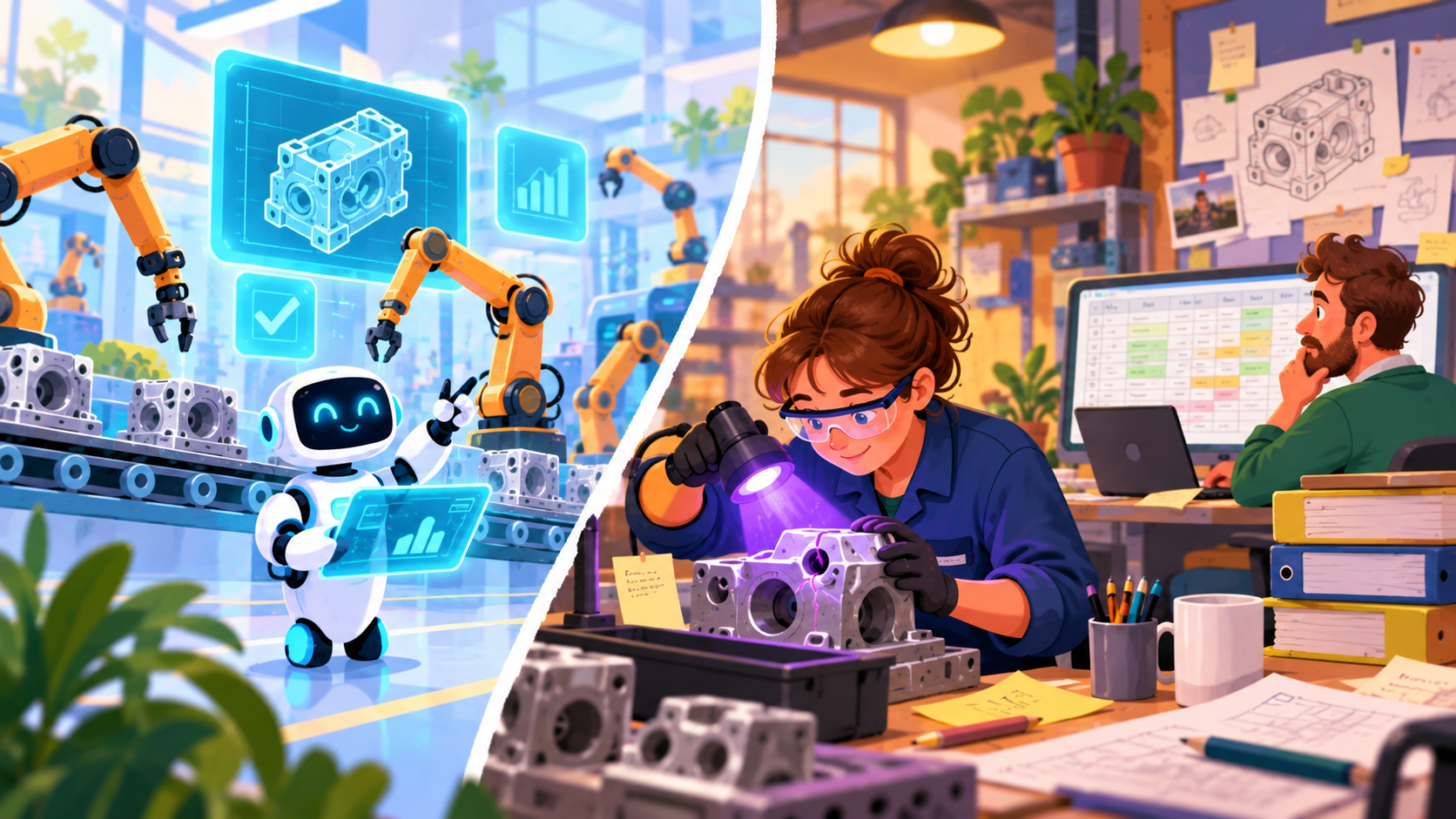
When you picture Industry 4.0, you probably have an image like this in mind: robotic arms moving around each other in perfect choreography, a digital twin that knows every single screw in real time, and somewhere in the background, an AI quietly optimizing away. A nice picture. But it has precious little to do with reality at most German manufacturing companies.
Here’s what reality often looks like: Manufactured parts are inspected automatically using a variety of techniques. Even so, the process still ends with a manual step: Certified inspectors take one more look at the parts by hand and sign off on the inspection with a stamp and a date. That final step is not captured automatically, at least not yet. A few rooms down the hall, the quote for an entire production line isn’t generated by an algorithm, but in an Excel spreadsheet that someone copied from the last more-or-less similar project and adjusted with a sharp pencil. Pictures that have little in common with the typical image of Industry 4.0. And yet they describe everyday life at many companies almost exactly.
A Pattern That Keeps Showing Up
In the GENIUS research project, we’re also looking at the manufacturing sector, especially small and midsize businesses. Whether it’s estimating the cost of a new production line or running the actual production, people mostly work with a mix of Excel, PowerPoint, PDF, and a firm reach for the last comparable project as a template. Standard processes are rare, but there are plenty of good reasons why.
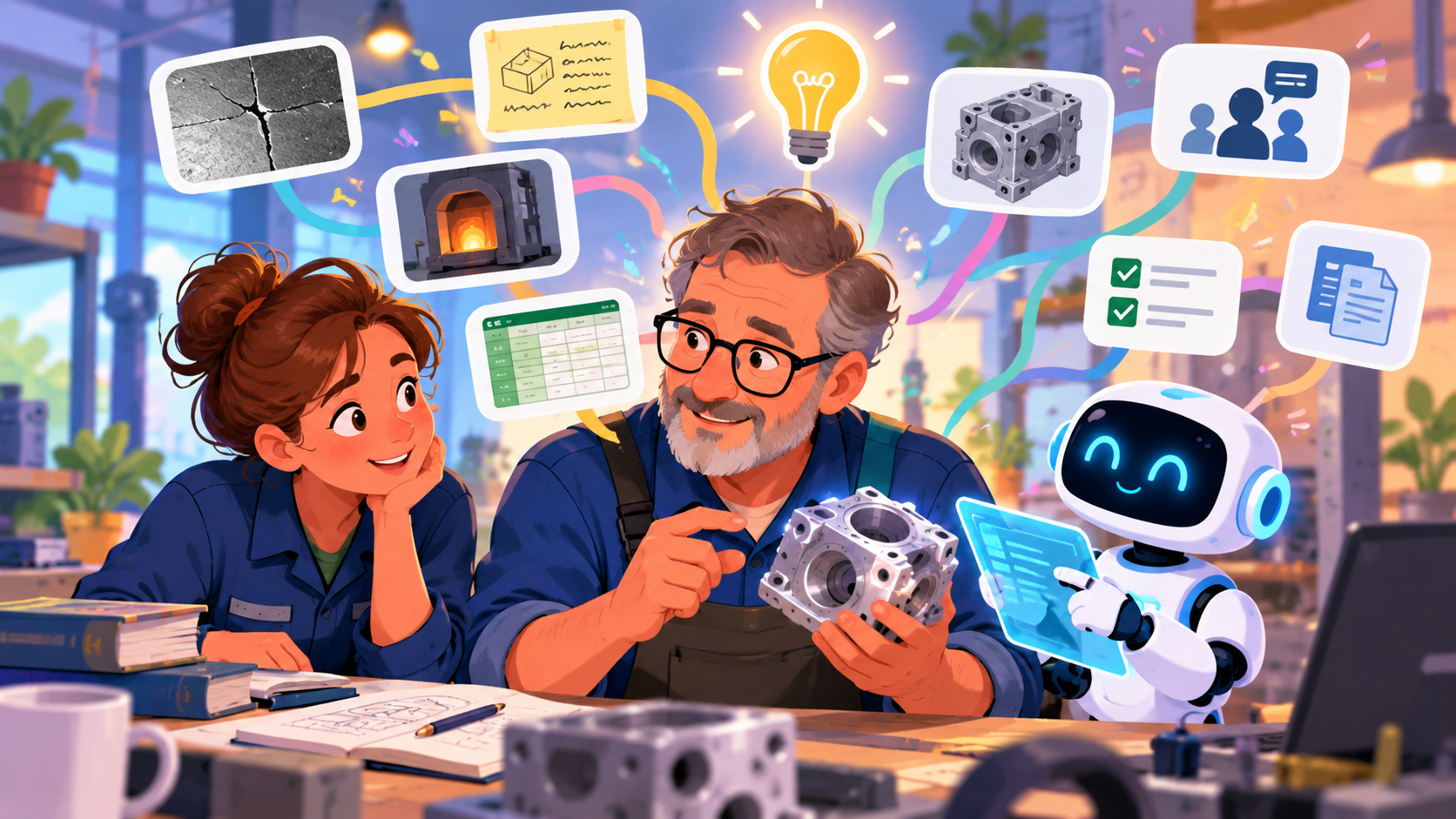
Sometimes the challenge is laying out a factory floor so that hot material doesn’t cool off unnecessarily before it moves on to further processing. Or making sure that heat-generating machines don’t end up right next to the ones that need cooling. Estimates are often calculated in person-days, based on experience. Not because no one could do it better, but because every project is different enough: A standard template would obscure more than it helps. Other times, quality depends instead on people who can spot a material defect before it can even be described in a data sheet. Or on expert knowledge of which furnace setting works for which part. In both cases, this isn’t a sign of being behind the times, but the logical response to a kind of manufacturing that rarely boils down to form fields.
Why Excel Is Sometimes the Smarter Choice
It’s tempting to dismiss all this as “they’re just behind the times.” That’s exactly where this falls short. If you work every day with parts that come in countless variants and with individual customers’ special requests, your processes rarely fit into a rigid system. A flexible Excel spreadsheet is then often the more sensible choice than an expensive off-the-shelf tool that doesn’t cover half of your cases anyway. The real problem lies elsewhere: The knowledge that keeps these processes running doesn’t live in a system, but in the heads of individual people. It’s hard to share and hard to scale. And it’s gone quickly once that person retires or leaves the company. In short: It’s complicated. As it almost always is when years of experience meet a system that doesn’t know that experience.
For small and midsize businesses, the stakes are doubly high. Unlike large corporations, smaller manufacturers rarely have their own digital transformation department that spends years developing a custom-built system. At the same time, according to the DIHK Skilled Labor Report 2025/2026, the skilled labor shortage hits small and midsize businesses especially hard: More than 40 percent of them are now struggling to fill open positions. Someone who has been in charge of quality inspection for three decades will eventually take their knowledge of crack patterns and material behavior home with them. And the vacant position can’t simply be filled with a replacement.
Where Artificial Intelligence Can Actually Close the Gap
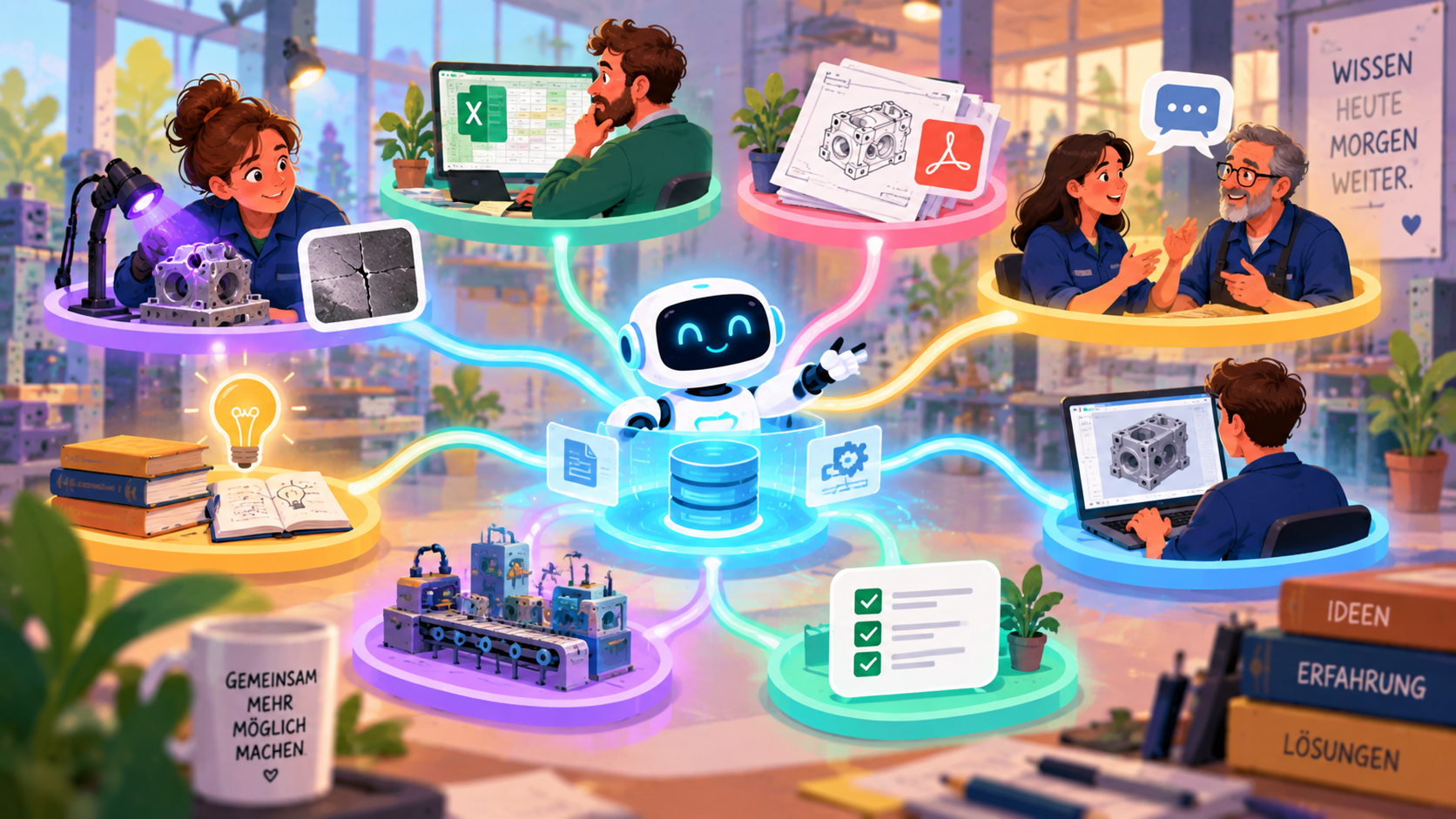
This is where it gets interesting. Not because AI is meant to replace the experienced colleague, but because it can make visible exactly what, until now, has lived only in her head. An AI-powered assistant doesn’t need to replace an existing system landscape to do this. It can start right where the knowledge already exists: in Excel spreadsheets, PDFs, old quotes, and in conversations with the people who know it best.
Here are two examples of what this can look like in practice:
An assistant walks new inspectors through the experience of their seasoned colleagues in a structured way: which crack patterns under UV light point to which problem, and which furnace setting works for which part geometry. That way, this knowledge stays accessible even after the experienced colleague eventually retires and can no longer train every new hire in person.
On the planning side, an assistant conducts a structured interview. It checks existing documentation against new regulatory requirements, such as the upcoming Digital Product Passport, flags the remaining gaps, and suggests how to close them. The result is a starting point for a quote, not a replacement for the experts who ultimately write it.
The Bridge to Factory Buddy
This is exactly where Factory Buddy comes in, the system being developed in the GENIUS project. It’s designed to connect scattered, often only implicit knowledge in a shared knowledge base and make it accessible through an assistant that understands what’s being asked. All without imposing a new, rigid system.
On the Way There
So much for the nice theory. It’s not quite as simple as it sounds. It’s complicated, after all. A prototype that gives a good answer once is a very different thing from an assistant that an experienced inspector still trusts after the third time using it. That’s exactly why this is one of the topics we’re researching in GENIUS together with our partners, rather than building off-the-shelf solutions. We want to find out how to build this kind of support so that it truly holds up in day-to-day work: reliable when it really counts, simple enough for the stress of daily operations, and robust enough to keep running dependably months after rollout.
Final Thoughts
The real Industry 4.0 story doesn’t play out on glossy dashboards, but among Excel cells, UV lamps, and the question of how a company preserves what its most experienced people know. If you take that reality seriously instead of dismissing it, you’ll find a starting point for AI in manufacturing that can make a real difference, especially for small and midsize businesses. It will probably stay complicated either way, just a little less so.