76 percent. That’s how confident a language model was according to its own confidence metric when asked, “What’s the weather like in Stockholm?” It replied that it didn’t have access to current data, but that it’s usually cool and rainy at this time of year. In fact, it was sunny and warm that day. The high confidence applied to the entire answer, not to the fact that it was merely a typical assessment, not an actual forecast for that day. And yet the model was 76 percent certain.
That’s the point. Not that the model was wrong, but that it didn’t know how wrong it was. In the GENIUS research project, we systematically investigated exactly that: We queried models, extracted confidence metrics, and evaluated the answers from a technical perspective. The result was always similar: The values were almost always above 70 percent regardless of whether the answer was correct and could be fact-checked. The model’s self-assessment was therefore hardly a reliable indicator of the actual quality of the answer. Language models are trained to sound plausible. They hardly ever realize when they actually don’t know something – self-doubt just isn’t their thing.
So we asked ourselves: How confident are you, really? And we decided not to leave the answer up to the model.
Structured Knowledge instead of Language Intuition
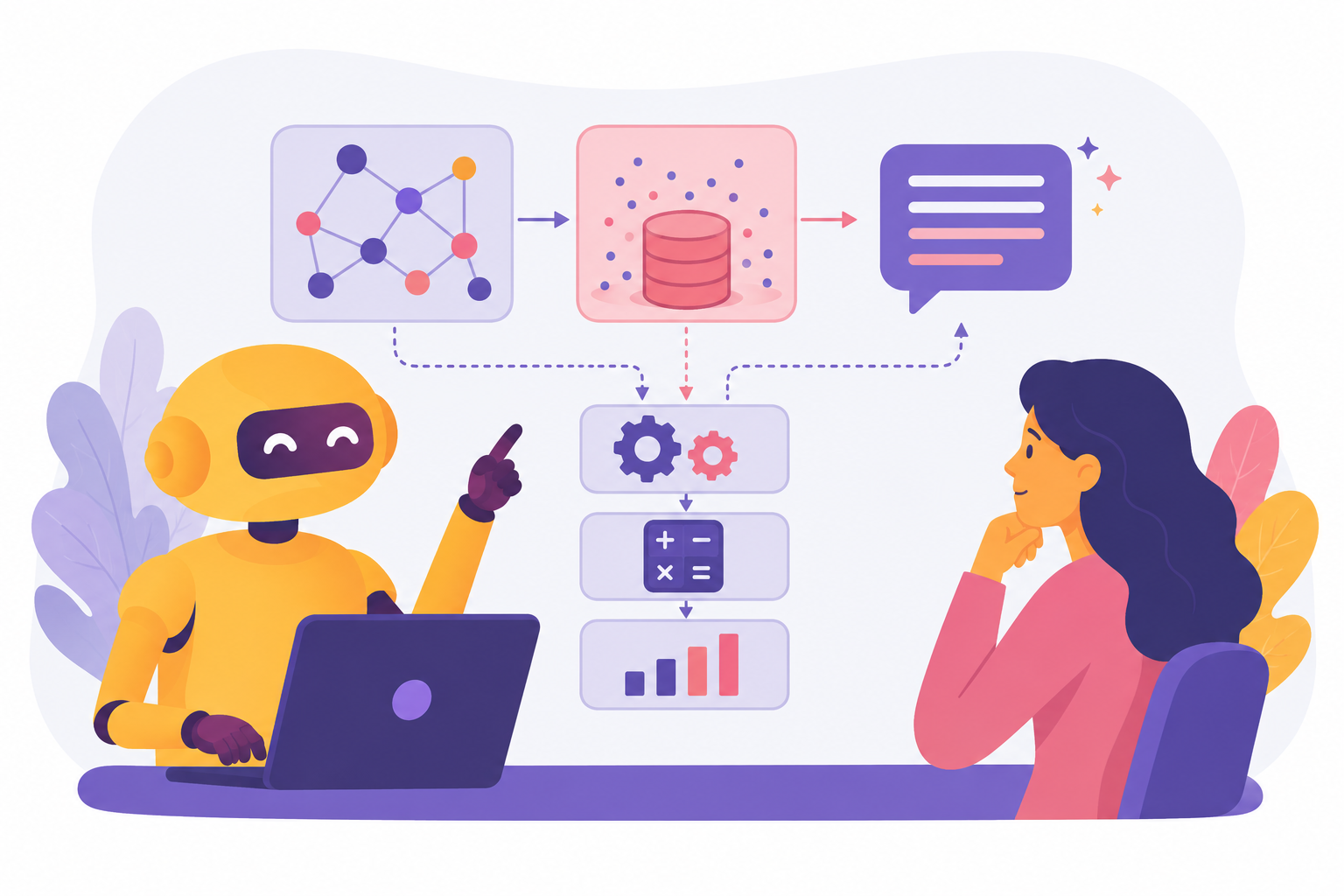
The approach we take at GENIUS is called Neurosymbolic AI. The idea is simple at its core: We store what we know and have validated through expert review in a structured RDF knowledge graph. This graph contains unambiguous facts, concepts, and the relationships between them. This is supplemented by a vector database that can also find content that isn’t an exact match but is semantically relevant to a query.
The language model uses this knowledge base to formulate answers and link information together. It is not intended to simply fill in gaps in knowledge on its own.
GENIUS is designed to do two things simultaneously: make existing expert knowledge accessible and incorporate new expert knowledge in a structured way. Both are important: a knowledge base that does not grow becomes outdated.
In factory planning, life cycle assessment in production, or the digital product passport, this is not merely an academic distinction. A system that confidently specifies the wrong maintenance interval is worse than none at all.
A System That Questions Itself
We are currently designing and evaluating a LangGraph-based agent with two paths: a read path for queries and a write path for knowledge maintenance. The two are more closely linked than one might initially think.
In the write path, new expert knowledge isn’t simply adopted. Every new piece of content undergoes an ontology evaluation: Does the new knowledge fit the existing structure? Are there any contradictions? Are new concepts needed that expand the ontology itself? And before any entry is added to the knowledge base, a human must always explicitly approve it. This “human-in-the-loop” principle for writing is not a safety net for emergencies, but rather an integral part of the design. This is because the quality of the write path directly determines the quality of the read path.
In the read path, the system performs self-checks at several stages:
- The query is broken down into a structured database query and a semantic search query.
- An internal classification system routes the query to the correct knowledge domain: factory planning, improving life cycle assessment processes in production, or the digital product passport.
- An internal validation step assesses whether the content found actually matches the query: structurally correct in terms of the ontology, not merely thematically related. If this is insufficient, the system reverts to the search up to two times—with a diagnosis of exactly what was missing.
- Only after this validation is passed is a response generated – and then checked once more against sources and subject-matter rules.
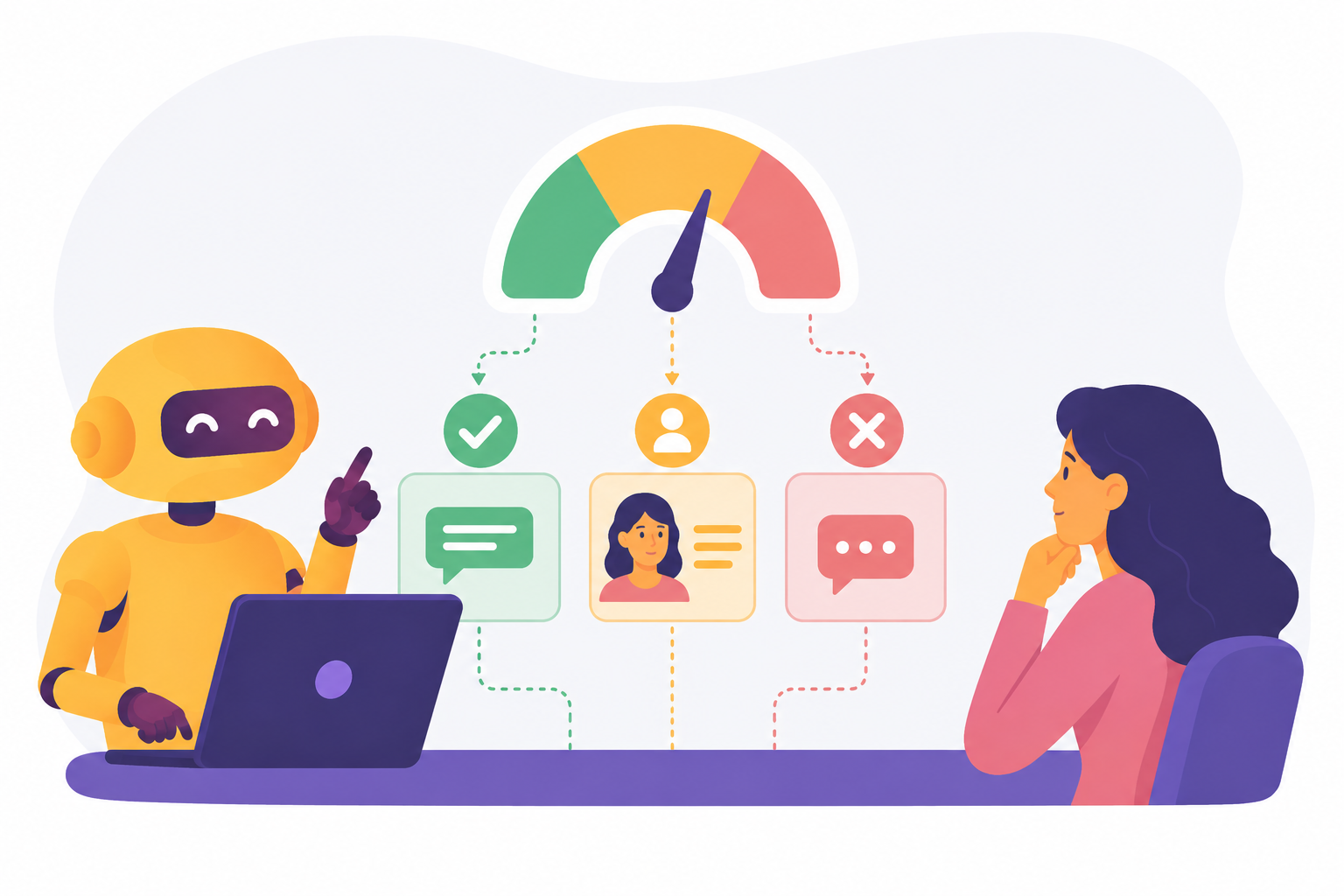
The reading path also includes a human review at one point. If the evidence is insufficient, the system rejects the answer. If it is only partially sufficient, a human takes over the review. If, on the other hand, it is sufficient, the answer is provided immediately.
Confidence You Can Verify
At the core of this approach is a final confidence score. It’s not what the model thinks of itself but rather what we can verify from the outside. It consists of three independent subscores, each of which answers a different question.
Retrieval Quality: Did the knowledge base match the query?
Before a response is even generated, we check how well the found content matches the query. Three factors are key here: How comprehensively does the knowledge graph cover the relevant concepts? How similar were the found documents in terms of content? And how trustworthy are the sources – manually reviewed, automatically validated, or simply extracted? Structured facts from the knowledge graph carry more weight than semantic similarity from the vector database because they are more reliable. If this score is insufficient, the system does not simply proceed: It attempts to search again up to two times, diagnosing the gap in the process. Faithfulness and domain checks are performed only afterward – never on a knowledge base that has failed this test.
Faithfulness: Is every statement in the answer supported by the sources?
This score is the most important of the three because it most directly measures whether the language model is hallucinating. To determine this, the generated response is broken down into individual statements, and each one is checked separately against the source content – not the response as a whole, but statement by statement. A response can be 80 percent correct and still contain a fabricated statement – that is exactly what this score is designed to reveal.
Domain Validity: Does the answer violate the guidelines?
Some errors aren't a matter of source reliability, but of subject-matter logic. This score evaluates the answer against domain-specific rules – such as standards, laws, or technical constraints in the relevant field. If such a rule is violated, we lower the score – regardless of how good the other subscores are.
The three subscores are deliberately not simply averaged. A low score noticeably drags down the overall result. This is because a good score in one dimension should not compensate for a critical error in another. Technically correct, but delusional? That won’t earn you a high overall score.
What the score is supposed to mean
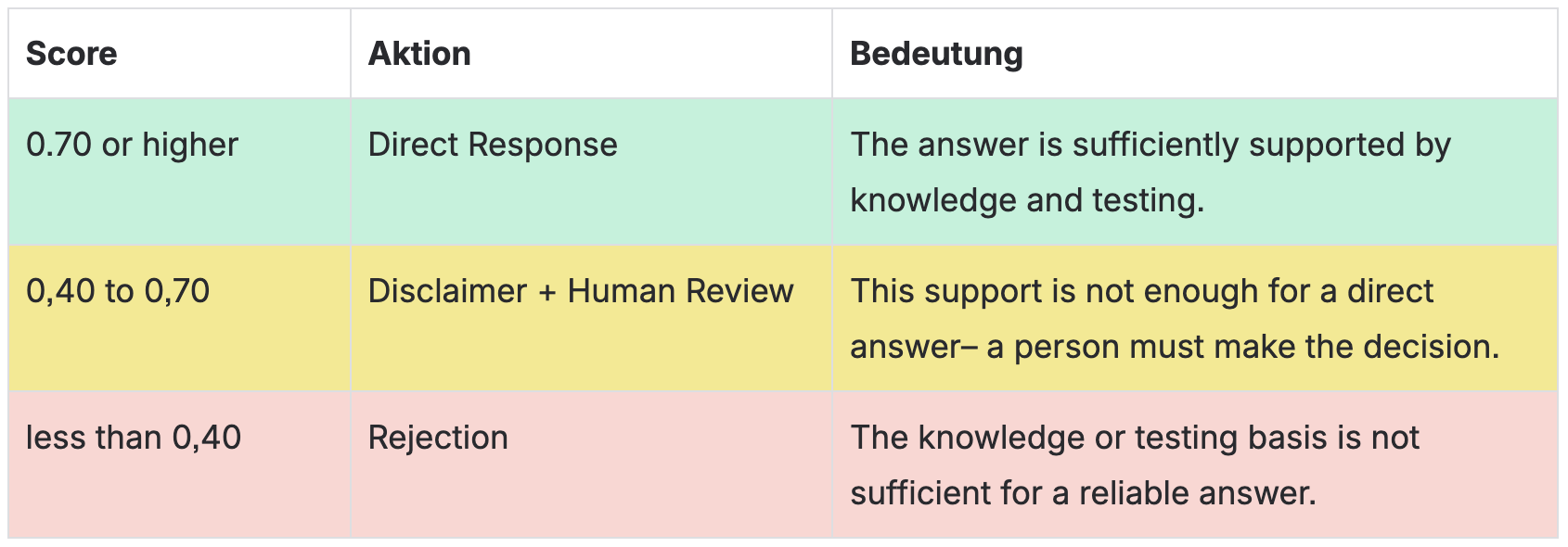
The values are based on common thresholds found in the literature on RAG and confidence scoring systems – but they are not fixed limits derived empirically for our specific use case. Whether these thresholds are accurate is one of the central questions of our evaluation. This is precisely why we need real-world scenarios.
From Research to Practice
Many AI projects fail not because of the technology, but because of a lack of trust. Either you trust the system blindly – and regret it. Or you don’t trust it at all – and just ignore it.
What we’re developing at GENIUS aims for something different: We want to understand what it takes for people to have well-founded trust in an AI system. Systems that show where an answer comes from, that know when they’re certain, and that involve a human exactly when it matters.
At pentacor, we evaluate these questions using real-world scenarios from the three areas mentioned. What we learn in the process will be incorporated into our client projects.
After all, the question “How confident are you, really?” isn’t just asked in research. It arises with every productive AI system whose answers influence real-world decisions. But perhaps we shouldn’t leave the answer to that question up to the AI itself.
76 percent alone is no longer enough for us – we’re working on an answer that doesn’t merely claim, but proves, just how confident it can be.